
In Japan, Trump’s Pearl Harbor joke elicits scorn and dismay
Sign up now: Get insights on Asia's fast-moving developments
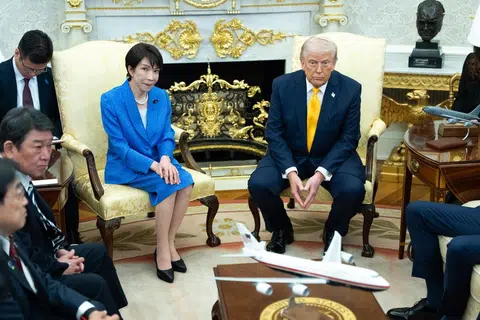
US President Donald Trump meeting Japanese Prime Minster Sanae Takaichi in the Oval Office of the White House on March 19.
PHOTO: EPA
Javier C. Hernandez and Hisako Ueno

WASHINGTON/TOKYO – US President Donald Trump’s meeting with Japanese Prime Minister Sanae Takaichi at the White House was the talk of Japan on March 20. But the focus was not just on investment deals and geopolitics: It was on Mr Trump’s Pearl Harbor joke.
In the Oval Office on March 19, Mr Trump made the crack while explaining why he did not give Japan advance notice of the attack on Iran.
“We didn’t tell anybody about it because we wanted surprise,” he said, with Ms Takaichi seated next to him. “Who knows better about surprises than Japan, OK? Why didn’t you tell me about Pearl Harbor, OK? Right?”
There was scattered laughter in the crowd of officials and journalists. Ms Takaichi widened her eyes and looked in the direction of the Japanese reporter who asked the question. She did not speak, sitting with her arms crossed.
Many Japanese scholars, politicians and commentators were aghast. Some criticised Mr Trump, saying he should not have revived a painful World War II chapter so casually. Others directed their anger at Ms Takaichi, saying she should have spoken up. Still others said they were concerned that it might harm ties between Japan and the US.
Commentator for broadcaster TV Asahi Toru Tamagawa said on a morning show that the comment showed “an unpleasant side of President Trump”.
“He doesn’t care at all that the Japanese Prime Minister is sitting next to him,” he said.
Professor Izuru Makihara, who teaches Japanese politics at the University of Tokyo, said in an interview that many Japanese would probably shrug off the joke, seeing it as just another over-the-top remark by Mr Trump.
But he added: “This is something that absolutely shouldn’t be said. He might start saying things like, ‘Hiroshima and Nagasaki were fine, weren’t they?’ For Japanese people, we can’t accept that.”
In Japan, the perception of the attack on Pearl Harbor on Dec 7, 1941, which led the US into World War II, is complicated. Some nationalists and older generations of Japanese still defend the assault as a necessary response to diplomatic bullying by the US, describing the war as unavoidable.
In the post-war era, when Japan officially adopted pacifism, there was more criticism of the attack. Still, interest in Pearl Harbor has waned among younger Japanese, who see the episode as remote and irrelevant, or are unaware.
Mr Trump’s remark surprised many people in Japan, who had grown accustomed to American presidents avoiding harsh discussion of Pearl Harbor. His predecessors have instead focused on deepening ties with Japan, America’s ally since the end of World War II.
Ms Takaichi, who worked hard during the visit to stay on Mr Trump’s good side, drew criticism for not saying something about the joke – and for her attempts to curry favour with him. At dinner on March 19, she complimented Mr Trump’s looks. And earlier in the day, she told him: “I firmly believe that it is only you, Donald, who can achieve peace across the world.”
Former diplomat Hitoshi Tanaka wrote on the social platform X that Ms Takaichi’s approach was “bizarre and embarrassing”.
“It’s a relationship between heads of state,” he wrote. “While some flattery is fine, if it’s overdone, it ends up repulsing the onlookers.”
Commenters found fault not just with Mr Trump and Ms Takaichi, but also with the Japanese TV journalist who asked the question of Mr Trump. Ms Takaichi also seemed unhappy with the reporter when she looked his way.
The Prime Minister and her office have not commented on the episode. Some said they felt sympathy for Ms Takaichi.
“The Pearl Harbor incident was not the kind of thing that could be countered on the spot,” former lawmaker Shiori Yamao wrote on Facebook. “Her calm attitude of letting it be said was also correct.” NYTIMES
